
How neuromodulation works
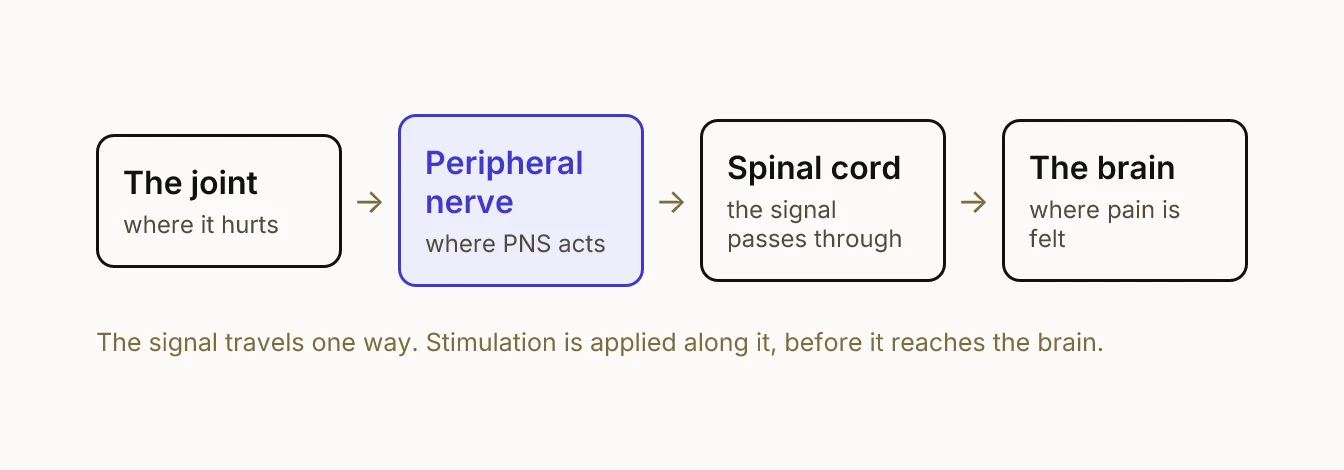
Pain is a signal. When a joint is damaged or inflamed, nerve fibers transmit electrical impulses from the affected area through peripheral nerves, up the spinal cord, and into the brain, where they're interpreted as pain. This signaling pathway is the target of peripheral nerve stimulation.
PNS works by delivering mild electrical impulses to the peripheral nerves near the affected joint. These impulses modulate — essentially interrupt or override — the pain signals before they reach the brain. The joint itself is untouched. The intervention happens entirely at the nerve level.
The gate control mechanism
The scientific foundation of PNS builds on gate control theory, first proposed in 1965 and refined over decades of neuroscience research. The theory describes how non-painful input can close the "gates" to painful input, preventing pain signals from traveling to the central nervous system.
PNS leverages this mechanism by stimulating large-diameter nerve fibers that carry non-painful sensory information. When activated, these fibers inhibit the smaller pain-carrying fibers, effectively reducing the pain signal that reaches the brain.
Precision targeting
Modern PNS systems use imaging guidance to place leads near the specific peripheral nerves responsible for pain in the affected joint. This precision means stimulation is focused exactly where it's needed — at the knee, hip, shoulder, ankle, spine, or other target area.
The stimulation parameters — frequency, pulse width, and amplitude — are customizable for each patient. Your physician adjusts these settings to optimize relief, and they can be fine-tuned over time as your body responds.
Why PNS differs from spinal cord stimulation
Spinal cord stimulation (SCS) targets the spinal cord itself and is typically used for diffuse or widespread pain conditions. PNS targets individual peripheral nerves and is designed for localized joint pain.
This distinction matters because peripheral targeting allows for more precise pain relief with fewer systemic effects. PNS is also less invasive than SCS — there's no surgery near the spinal cord, and the risk profile is meaningfully lower.
The biological response
Beyond the immediate gate control effect, emerging research suggests that sustained peripheral nerve stimulation may induce neuroplastic changes — the nervous system adapts over time, potentially reducing pain sensitivity even when stimulation is paused.
This is an active area of clinical investigation, and it represents one of the most promising aspects of PNS: the potential for the treatment to create lasting changes in how the nervous system processes pain, rather than simply masking symptoms.