
The treatment spectrum
Joint pain treatment isn't binary — it's not simply "live with it" or "replace it." Between those extremes sits a spectrum of interventions, each appropriate at different stages of joint degeneration and pain severity. The ARC Decision Model maps this spectrum into three clear phases: Preserve, Modulate, and Replace.
The model's core principle is sequencing: start with the least disruptive effective intervention and escalate only when clinically appropriate. This ensures patients aren't jumping to irreversible procedures when a less invasive option could provide meaningful relief.
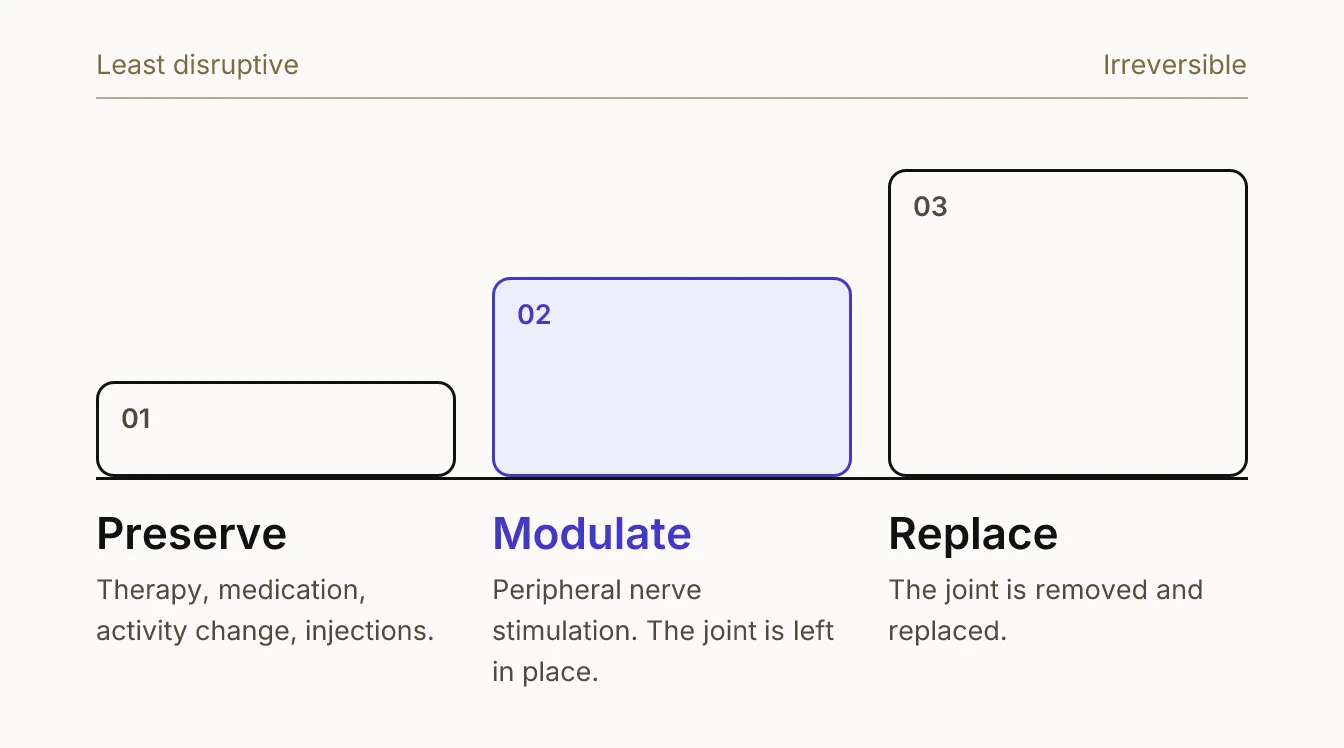
Phase 1 — Preserve
The first phase focuses on preserving the natural joint through conservative care: physical therapy, activity modification, anti-inflammatory medication, and targeted injections (corticosteroid or hyaluronic acid). These interventions address inflammation and mechanical stress without altering the joint structure.
For many patients, preserve-phase treatments provide sufficient relief. When they don't — when pain persists despite consistent conservative care — the model advances rather than repeating the same interventions indefinitely.
Phase 2 — Modulate
The modulate phase introduces peripheral nerve stimulation. Instead of treating the joint itself, PNS targets the pain signaling pathway. This is the critical intermediate step that most traditional treatment models skip entirely.
Modulation is appropriate when conservative care has been insufficient but the joint's structural integrity still supports preservation. The joint anatomy matters here — PNS works best when there's still something worth preserving, and the primary complaint is pain rather than complete structural failure.
Phase 3 — Replace
Replacement is the final phase, reserved for joints where structural deterioration is severe enough that neither preservation nor modulation can provide adequate relief. Bone-on-bone arthritis, significant deformity, or complete loss of mechanical function are typical indicators.
The ARC model doesn't oppose replacement — it respects it as a powerful intervention and ensures it's deployed at the right time, for the right patient, after less invasive options have been appropriately explored.
Why sequencing matters
The traditional model often jumps from conservative care directly to replacement, skipping the modulate phase entirely. This means patients who could have found relief through PNS are instead undergoing irreversible surgery.
Sequencing protects patients. If PNS provides sufficient relief, the patient avoids surgery entirely. If it doesn't, the patient still has replacement available — they've lost nothing except a small amount of time. The asymmetry of outcomes heavily favors trying modulation first.
Shared decision-making
The Decision Model is a framework, not a mandate. Every patient's anatomy, pain profile, lifestyle, and preferences are different. The model provides structure for the conversation between patient and physician, ensuring all options are considered before irreversible steps are taken.
A framework like this one is there to guide the clinical discussion, put the evidence on the table, and align on a treatment path that matches a patient's specific situation and goals.